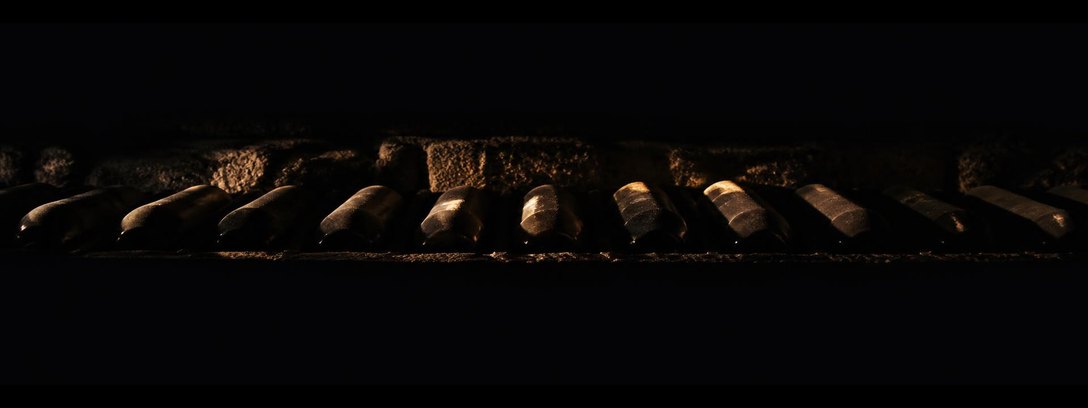
Twelve millimetres
A standard 750 mL bottle finished with a cylindrical cork is often designed with just over twelve millimetres of ullage at 20°C. That small reserve is there for a physical reason: wine expands as it warms. It is not the whole science of cellaring, but it makes one thing unusually easy to see — why stability matters, and why the number on a cabinet display is not enough.
There is a number built into the filling specification of many bottles in your cellar, and almost nobody selling wine storage will mention it to you.
The space between the surface of the wine and the underside of the closure is the ullage. For standard cork-mouth bottles, Australian guidance specifies more than twelve millimetres at 20°C; Amon and Simpson recommend at least thirteen millimetres for a nominal 750 mL bottle. The purpose is explicit: leave enough volume for the wine to expand as temperature rises.
The number is not universal. Screw-cap finishes can require substantially more headspace, and the correct fill depends on the bottle, closure, filling temperature and internal pressure. But twelve millimetres is useful because it makes the engineering visible.
A bottle is filled with a margin. Temperature is what spends it.
What happens when the margin disappears
The AWRI has documented what follows. In its investigations, bottles with low ullage developed leakage problems when subjected to what it calls moderate heating — around 35°C. As the wine expands, the remaining gas space shrinks and bottle pressure rises; the AWRI reports pressures above 50 kPa in low-ullage cases.
If the wine reaches the closure, the consequences can include wine travelling into or past the stopper, leakage, or movement of the closure itself.
That matters because the AWRI’s visual checks for suspected heat exposure include leakage, closure damage, wine travel or seepage on the cork, increased ullage and label damage.
That is the field guide on this site, read from the other end. Reading the bottle teaches you to recognise those marks on a bottle someone is offering you. This note is about the years in which those marks are either made or avoided — in your own house, by a machine you chose.
For the record: the bottles in this archive age under bond, in professional custody. This note is for the other bottles — the ones that live with you. How to store fine wine draws the wider map; this is about the machine.
The scale is small — and honestly uncertain. Expansion tables collated by the AWRI put the change in a 750 mL bottle across a ten-degree rise at roughly 0.7 to 2.5 mL, depending on the wine’s composition and on which published dataset you trust; the datasets themselves disagree. The exact figure varies. The lesson does not: the total margin in a cork-finished bottle is itself only a few millilitres deep, and temperature spends it in millilitres. There is less spare volume than the neck of a bottle makes you think.
The first thing that matters is not the number on the display

There is no single temperature that turns a cabinet into a cellar. Around 12–14°C is a common long-term ageing target, while the AWRI’s older technical guidance describes 15–20°C as a cool storage range and warns that prolonged exposure above 25°C, or short exposure above 40°C, can affect wine quality.
The stronger conclusion is about stability. The AWRI specifically advises avoiding significant thermal cycling between day and night. In one AWRI experiment, every closure type tested showed elevated oxygen transmission under a 17–28°C daily cycle, compared with steady storage at 17°C — with the natural cork set also becoming markedly more variable. The sample was small and the authors call for larger sets; the direction, however, was uniform.
That does not mean that every small compressor fluctuation damages a bottle, or that a cabinet at 15°C is automatically superior to one at 12°C. It means that an average temperature can hide a poor control system.
So ask for the curve, not the setpoint.
A cabinet is worth what its worst hours look like. Very few manufacturers publish bottle-level cycle amplitude in a form that lets one model be compared honestly with another.
The two-zone cabinet answers a question about dinner, not about ageing
Red, white, sparkling and fortified wines do not require separate temperatures for long-term storage. What differs much more is serving temperature.
That makes a dual-zone cabinet useful when one appliance has to do two jobs: age wine and keep bottles close to service temperature. It does not make two zones an inherent advantage for ageing.
For a collection whose purpose is long-term keeping, a single-zone cabinet is usually the simpler instrument: more of the internal volume can be devoted to one stable condition, and there is less reason to manage two thermal environments. Some dual-zone models can, however, set both zones to the same ageing temperature; in that case the objection is practical rather than scientific — capacity, complexity and cost.
Buy two zones because you need two functions, not because red and white wine age at different temperatures. They do not.
The lit door
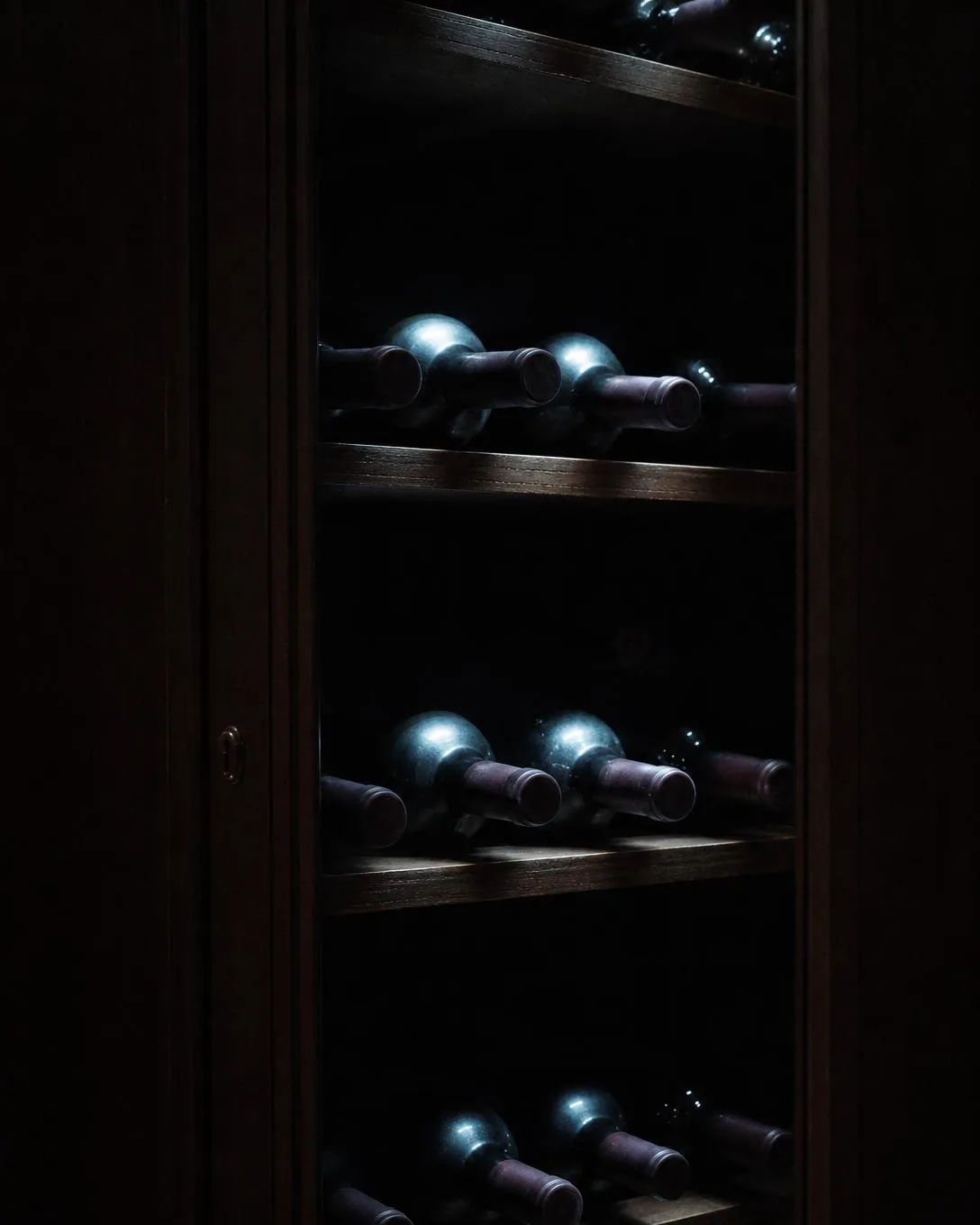
Lightstrike is not folklore. Riboflavin in wine absorbs strongly in the near-UV and blue-visible region, with important absorption around 370 and 440–450 nm. Light-driven reactions involving riboflavin and sulfur-containing compounds can generate volatile sulfur compounds responsible for the fault known as goût de lumière or light-struck aroma.
The important point is that UV is only part of the problem. Blue visible light overlaps the sensitive region too. A door described only as “UV-filtered” therefore tells you less than it appears to.
And there is a correction worth making to almost every generic cabinet guide: LED is not automatically safe — and neither is it automatically dangerous. A Food Chemistry study (online 2021) exposed white and rosé wines to contrasting light sources for ten days: the greatest degradation of riboflavin came under ultraviolet-rich light, while the LED sources in that trial produced minimal degradative effects. A 2026 OENO One study then tested a common cool-white LED whose emission peaks near 451 nm — squarely inside riboflavin’s sensitive region: under its test conditions, it produced the fastest riboflavin degradation of the sources tested, faster even than cool-white fluorescent, while a yellow LED emitting only above 500 nm was materially less damaging, and darkness remained the reference. The two trials do not contradict each other; they tested different lamps. What decides the matter is the spectrum each source emits, not the letters on the box.
Nor does light act on wine through one pathway alone. The same research group has since examined a second light-driven route in a 2026 Food Chemistry study — the production of glyoxylic acid from tartaric acid, a reaction whose critical wavelengths sit below 520 nm. Different pathways answer to different regions of the spectrum: one more reason a technology label cannot settle the question.
So the buying rule is not “LED”. It is darkness by default.
If the cabinet must be illuminated, the light should be switchable completely off, used briefly, kept at low intensity and, ideally, shifted away from the blue region toward a warmer amber/yellow spectrum. No spectrum should be treated as universally harmless: dose, bottle colour, distance, wine composition and exposure time all matter.
A permanently illuminated cabinet is not a cellar with a view. It is an exposure experiment.
Three things that are less certain than the brochures suggest
Humidity. The broad principle is supported: very dry conditions can be undesirable for natural closures, while excessive humidity creates its own practical problems. The AWRI notes that humidity matters but also that it is not actively adjusted in most storage facilities. Consumer guidance often converges around a broad mid-range rather than one scientifically privileged number. The useful buying question is therefore whether the cabinet avoids sustained extremes — not whether its display can promise 67.0%.
Bottle orientation. Skouroumounis and colleagues stored Riesling and wooded Chardonnay under several closures and orientations for five years and found that orientation had little effect on chemical composition or sensory properties under the conditions studied. Lopes and colleagues likewise found oxygen ingress to be independent of storage position for most closures during the first 24 months; closure type mattered far more. Mas and colleagues reported higher oxidation in upright bottles sealed with agglomerated cork — elevated acetaldehyde from the third month onwards — although the broader orientation differences in that study were not statistically significant; Godden and colleagues likewise found that upright storage tended to accelerate sulfur-dioxide loss for several closures, often only marginally. The sensible long-term convention therefore remains horizontal storage for cork-finished bottles — the AWRI still recommends keeping natural cork in contact with the wine — but the literature does not support treating a bottle left upright for weeks as damaged. And do not mistake horizontal shelving itself for sophisticated preservation technology. Shelf geometry matters mainly because real collections contain Burgundy, Champagne and large-format bottles, not because a month upright is a catastrophe.
Vibration. The evidence is neither zero nor decisive. An older AWRI technical note said the Institute could find no literature specifically supporting the claim that refrigerator-compressor vibration harms wine. That statement is historically accurate — but it is no longer the end of the story. A 2008 study exposed a commercial red wine to continuous vibration at several intensities for 18 months and found faster changes in some physico-chemical parameters at higher vibration levels. What it did not establish is that the vibration reaching a bottle in a well-designed domestic wine cabinet is comparable to those experimental exposures, or that consumers can rank cabinets meaningfully from an “anti-vibration” badge. A later study closer in concept to storage-level microvibration — twelve months of sustained low-frequency vibration applied to a bottled Pinot Noir, published in 2022 — found no significant differences in phenolic or volatile composition between treatments, with modest sensory effects on the pace of evolution; damping the vibrations slowed it. If a published bottle-level measurement exists that would let one cabinet’s vibration be compared with another’s, we have not found it. The domestic dose remains the missing number. Treat vibration as a real but poorly quantified variable. Do not let it outrank temperature control, light management and failure alarms unless the manufacturer gives you measurements.
Seven questions, and what a refusal to answer tells you
What is the temperature swing at bottle level across a full cooling cycle?
Not the setpoint. The swing. If they answer “±0.5°C”, ask where the sensor was placed, whether the figure is air temperature or liquid-equivalent temperature, whether the cabinet was full and over what period it was measured.
What is the difference between the warmest and coolest shelf when the cabinet is full?
A tall cabinet can stratify. Capacity and circulation change airflow, so an empty-unit test tells you less than a loaded one.
Compressor or thermoelectric — and what ambient range is the unit rated for?
Thermoelectric systems remove the compressor and are usually quieter with less mechanical vibration, but their cooling capacity is more dependent on ambient temperature. Compressor systems generally cope better with hot rooms. Choose for the hottest room the cabinet will actually see, not for the average month.
Can it heat as well as cool?
A cooling-only cabinet cannot hold 12°C in a room that spends winter at 6°C. If the cabinet will live in a garage, basement or second home, ask for the permitted ambient range and whether it has an active winter/heating function.
Can the interior light be switched off completely — and can they state its spectral output?
“LED” is not an answer, and neither is a colour temperature: cool white, warm white and amber are descriptions, not measurements. Ask for the dominant wavelength range, and whether permanent illumination can be disabled.
What is the capacity in the bottles I actually own?
Headline capacity is normally based on standard Bordeaux bottles. Manufacturers themselves acknowledge that wider bottles reduce real capacity dramatically. Ask for Burgundy and Champagne capacity, shelf spacing and large-format compatibility — and for the figure in writing, per model.
What happens when temperature leaves the safe range — and will I know if I am away?
A local beep is useful only if somebody is there to hear it. For a serious collection, remote temperature alerts and power-failure awareness are higher-value features than much of what is sold as luxury.
The test nobody will suggest
Before you trust a cabinet with anything you care about, log it.
Ideally use two measurements for at least a week with the cabinet loaded as you intend to use it: one sensor for cabinet air and one temperature probe in a water-filled 750 mL bottle, or an equivalent liquid proxy, placed at bottle level. The air sensor shows what the cooling system is doing; the liquid proxy shows what something with the thermal inertia of a bottle experiences. Manufacturer support material from La Sommelière makes the same practical distinction, recommending a thermometer in a water-filled bottle when checking regulation.
Then use the cabinet normally. Open it. Remove bottles. Put them back. Let the room warm during the day.
Look for three things: the amplitude of the cycle, the difference between shelves, and recovery after the door has been opened. Do not panic at every air-temperature sawtooth — air moves much faster than 750 mL of liquid. What matters is whether the cabinet keeps the bottles in a narrow, uneventful thermal environment and recovers without long excursions.
That curve is closer to the actual product than the number printed on the door.
At a comparable ageing temperature, a cabinet that costs half as much and holds the flatter bottle-level line is the better cellar.
What to discard
Interior lighting that cannot be switched fully off. Especially for long-term storage of white, rosé and sparkling wines in clear or lightly coloured glass.
Dual-zone marketing that tells you red and white wines need different ageing temperatures. Buy two zones for service flexibility, not for a storage claim that is false.
“Anti-vibration” as a premium feature without a measurement. The variable is plausible and some experimental evidence exists; the domestic dose is the missing part.
Humidity precision presented as certainty. A broad safe range is useful. A decimal without method, sensor location and tolerance is decoration.
Thermoelectric cooling outside its rated ambient conditions. Quiet is irrelevant if the unit cannot pull the cabinet down to temperature in the hottest room it will face.
Capacity quoted only in Bordeaux bottles. A collection is not an energy-label test load.
A cabinet with no meaningful failure warning. A beautiful cellar that can fail silently is still a bad instrument.
The reading
What survives scrutiny is a short list: cool, steady, dark, correctly loaded and monitored.
The surprising part is how little of that is captured by the number glowing on the front of a cabinet, and how often precision in a brochure describes the control panel rather than the conditions around the bottle.
A standard cork-finished bottle may begin with barely more than twelve millimetres of ullage at 20°C. That is not the whole reason a cellar exists. It is simply the most visible reminder that preservation is a problem of margins.
The best cabinet does not perform for you.
It keeps the curve boring.
— The Empty Drops
Sources & further reading
- Australian Wine Research Institute (AWRI) — Applying cylindrical closures. Standard cork-mouth ullage >12 mm at 20°C; Amon & Simpson ≥13 mm for nominal 750 mL bottles; low-ullage leakage under moderate heating; bottle-pressure discussion.
- AWRI — Oxygen pick-up during packaging / total package oxygen. Purpose of ullage and distinction between cylindrical cork and screw-cap headspace requirements.
- AWRI — Transport and storage. Thermal cycling; heat exposure; humidity; closure movement/leakage; visual indicators used when assessing suspected heat damage; bottle orientation.
- AWRI TN07 — Thermal expansion data for wine. Collated expansion tables (Levreau et al. 1977; Tremblay 1984; Vinkem): a 10°C rise expands 750 mL of dry wine by roughly 0.7–2.5 mL depending on composition and dataset — the datasets themselves disagree.
- AWRI TN09 — The effects of heat and light on wine during storage. Heat thresholds, historical vibration statement, early lightstrike evidence and 370/440 nm riboflavin sensitivity.
- Hirlam, K.C., Scrimgeour, N., Wilkes, E.N. (2019). Orientation and temperature cycling impacts on the oxygen transmission rate of wine closures. Poster, 17th Australian Wine Industry Technical Conference. All four closures tested showed elevated OTR under daily 17–28°C cycling versus steady 17°C; small sample, further work called for. Companion article: The impact of temperature fluctuations on closure performance, Aust. N.Z. Grapegrower Winemaker 671:59–61.
- Godden, P. et al. (2001), Australian Journal of Grape and Wine Research 7:64–105. DOI 10.1111/j.1755-0238.2001.tb00196.x. Closure performance in a Semillon: upright storage tended to accelerate SO₂ loss for several closures, in many cases marginally.
- Mas, A., Puig, J., Lladó, N., Zamora, F. (2002), Journal of Food Science 67:1374–1378. Sealing and storage-position effects: higher oxidation in upright bottles under agglomerated cork (elevated acetaldehyde from month 3); broader orientation differences not statistically significant.
- Skouroumounis, G.K. et al. (2005), Australian Journal of Grape and Wine Research 11:369–377. DOI 10.1111/j.1755-0238.2005.tb00036.x. Five-year closure/orientation study on a Riesling and a wooded Chardonnay; bottle orientation had little effect on composition and sensory properties under the study conditions. (Its companion paper on ascorbic acid occupies 11:355–368; the two are frequently confused, including by the AWRI’s own storage page.)
- Lopes, P. et al. (2006), Journal of Agricultural and Food Chemistry 54:6741–6746. DOI 10.1021/jf0614239. Oxygen ingress driven primarily by closure type and independent of storage position for most closures during the first 24 months.
- Chung, H.-J. et al. (2008), Journal of Food Composition and Analysis 21:655–659. DOI 10.1016/j.jfca.2008.07.004. Continuous-vibration experiment on commercial red wine: 1, 5, 10 and 20 Gal over 18 months; faster physico-chemical changes at the higher intensities.
- Mislata, A.M., Puxeu, M., Nadal, M., de Lamo, S., Mestres, M., Ferrer-Gallego, R. (2022; online 2021), Food Chemistry 371:131144. DOI 10.1016/j.foodchem.2021.131144. Ten-day exposure of white and rosé wines to contrasting light sources: greatest degradation of aromatic precursors, mainly riboflavin, under ultraviolet light; the LED sources tested produced minimal degradative effects.
- Vongluanngam, I., Blackman, J.W., Schmidtke, L.M., Wilkinson, K.L., Zhang, X., Clark, A.C. (2026), OENO One 60(1). DOI 10.20870/oeno-one.2026.60.1.9377 — Photodegradation of riboflavin in white wine: impact of contrasting light sources and ethanol contents. Cool-white LED (emission peak ~451 nm) produced the fastest riboflavin degradation among tested light sources, correlating with photon energy in the 350–520 nm range; yellow LED (>500 nm) was substantially less damaging; darkness remained optimal.
- Vongluanngam, I., Blackman, J.W., Zhang, X., Schmidtke, L.M., Wilkinson, K.L., Clark, A.C. (2026; online 2025), Food Chemistry 503:147729. DOI 10.1016/j.foodchem.2025.147729 — Photochemical glyoxylic acid production in white wine: impact of light sources and ethanol concentrations. Companion study on a second light-driven pathway; critical wavelengths for the iron-tartrate route sit below 520 nm (Clark et al. 2011, J. Agric. Food Chem. 59:3575–3581).
- Poggesi, S., Merkytė, V., Longo, E., Boselli, E. (2022), Foods 11(18):2761. DOI 10.3390/foods11182761. Twelve months of sustained low-frequency microvibrations on a bottled Pinot Noir: no significant differences in phenolic or volatile composition; modest sensory effects on the pace of evolution, reduced by damping.
- Natural Cork Council — Bottling Handbook / Headspace Calculators. Fill-height and headspace model for a standard 750 mL claret bottle (conversion ≈2.9 mm/mL; typical ullage of a few millimetres), with the warning that other bottle geometries differ and that overfilling is the classic cause of leaking bottles.
- Wine Enthusiast — Wine storage temperature / single vs dual zone. Secondary consumer guidance: all wine types age in the same general temperature range; service temperatures differ.
- EuroCave / La Sommelière / Liebherr technical guidance. Useful manufacturer documentation for ageing vs service cabinets, temperature gradients, ambient-temperature limits, bottle-capacity conventions and monitoring features. Manufacturer claims should be treated as specifications to verify, not independent evidence.